Back to projects
Case study
Nebula PDF Generator
Nebula PDF Engine is a personal open-source npm library I built: JSX-driven PDF generation with Flexbox-style layout, automatic pagination, and first-class tables, without Headless Chrome. It targets server-side and edge runtimes where a small footprint and predictable layout matter more than shipping a browser binary.
Visit live siteThe Challenge (The “Why”)
I started Nebula as a personal project because I could not find a PDF stack that performed well in both implementation and developer experience. Puppeteer was too heavy, and it did not work in my environment: workloads were predominantly server-side and could not run a Chromium browser. pdfmake was usable, but the developer experience was rough: layouts were expressed through table hacks, basics like border radius were unavailable, and images had to be inlined as base64, which made templates long and hard to maintain.
The Technical Strategy (The “How”)
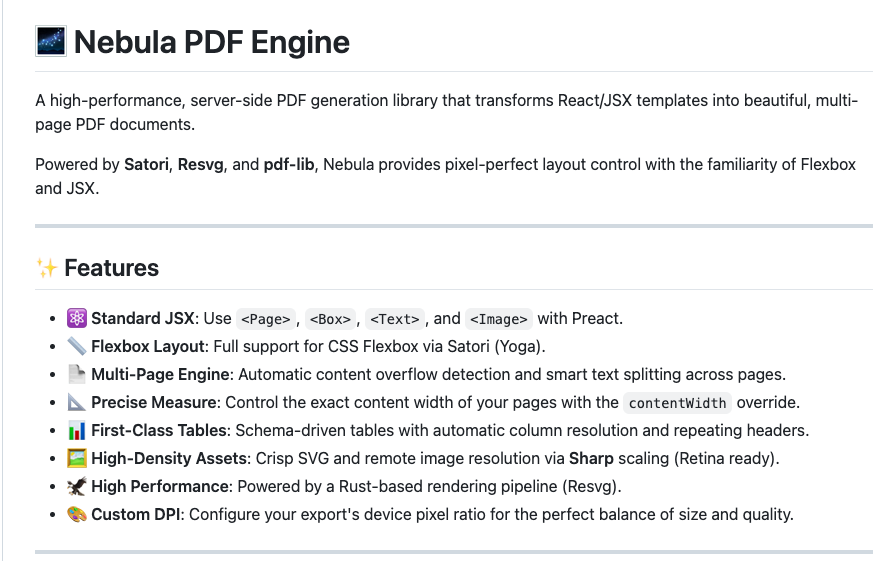
Nebula PDF Engine is a server-side generator that turns React/JSX templates into multi-page PDFs without Puppeteer. Layout is powered by Satori (Yoga-backed Flexbox) so you work with familiar primitives: Page, Box, Text, Image, and a schema-driven Table. Rendering uses Resvg for SVG work, pdf-lib for assembling the document, and Sharp for scaling remote images and SVGs at configurable DPI. Preact is the JSX runtime. A dedicated layout engine measures content, splits overflow at safe word boundaries, paginates tables with repeating headers and atomic rows, and supports both automatic overflow and explicit multi-page documents. The package is intentionally small and edge-friendly compared to Chromium-based stacks, and ships optional NestJS integration (NebulaPdfModule) for injecting a PDF service in Nest apps.
The Key Features & Contributions
- Standard JSX API (Page, Box, Text, Image, Table) with Preact; TypeScript-friendly configuration (jsxImportSource preact)
- Flexbox layout via Satori, multi-page engine with automatic overflow and manual pagination for sectioned documents
- First-class Table primitive: schema-driven columns, header repetition across pages, atomic rows, flexible widths (points, percentages, flex)
- Layout pipeline: measurement pass, bin packing, table-aware pagination, and splittable text vs atomic rows/images/boxes
- High-density assets: Sharp-based scaling, optional device pixel ratio for export quality; Rust-backed rendering path via Resvg
- Published as MIT-licensed npm package nebula-pdf-engine with docs and quickstart for standalone Node and NestJS consumers
The Impact (The “Results”)
The library gives teams a deterministic, Flexbox-native PDF workflow without Puppeteer’s footprint or pdfmake’s layout constraints. It fits invoices, automated reports, and dense shipping-style documents in serverless and edge environments where a small install and fast cold starts matter.
Technical Stack
TypeScript Preact Satori Resvg pdf-lib Sharp